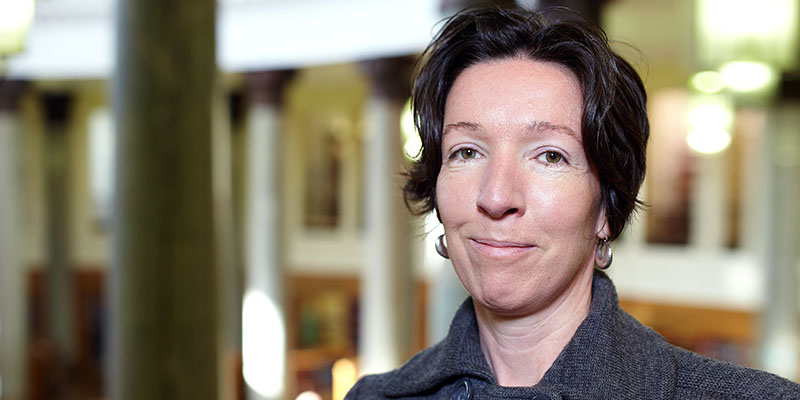
A19 in association and Boundaries of Literature are pleased to announce a seminar with Dr Alice de Galzain, postdoctoral researcher at Sorbonne Université. She will give a paper called ‘Cultivating the Roots of Feminism: Health, Gender and Reform at Brook Farm and the Fruitlands’. Please see below for an abstract and bio.
6th March, 4:30pm, Room 830, Olyme de Gouges Building, Université Paris Cité
Abstract
At the end of her life, Caroline Healey Dall returned to the topic of Margaret Fuller’s feminism, commenting, almost sixty years after the latter’s death, on the solidarity that marked her relationships with other women: “My lectures had made me very well known as a friend of Margaret Fuller, and many persons came to me, who owed safety and a home to her care, asked and granted, when they were strangers to each other. They never shrank from telling what they owed to her.”
The fact that Dall chose to anchor Fuller’s memory in the impact she had on her
community counters the tendency to see her as an exceptional woman, almost in isolation from her contemporaries, which, for a long time, was a defining element of how Fuller was remembered. In this paper, and more generally in my projected monograph, provisionally entitled Cultivating the Roots of Feminism: Health, Gender, and Reform at Brook Farm and the Fruitlands, I will examine how the notion of “community” was central to the writings produced by the women who lived in Transcendentalist utopias. While mapping the influence that Margaret Fuller had on these women, I aim to demonstrate that their writings were much more a reflection of Fuller’s Transcendental feminism than they were of an Emersonian type of disembodied (male) individual. I will discuss the meaning of “community” through the lens of four different relationships in the context of these Transcendentalist utopian experiments, paying particular attention to these women’s reformist discussions on health and the environment. First, I will look at Margaret Fuller and Sophia Ripley’s relationship, focusing on how the two women bonded over pedagogy while discussing the best way forward with regard to (Fuller’s brother) James Lloyd’s learning difficulties, when he was a student at the Brook Farm school. Then, I will comment on Marianne Dwight Orvis and Anna T. Q. Parsons’s friendship, of which Letters from Brook Farm provides a detailed record, expanding my reflection to the meaning of Mesmerism for Transcendentalist women and its impact on these women’s relationship with their bodies. Thirdly, I will look at Fuller and Georgiana Kirby Bruce’s relationship, examining the impact that Fuller’s mentoring and moral support had on Bruce’s long, feminist career. Finally, I will briefly discuss Abigail Alcott and Ann Page’s relationship at the Fruitlands (where they were the only women, juggling caring responsibilities and a heavy agrarian workload)—a relationship about which a lot of archival “discovery” (rather than “recovery”) work is still needed.
Bio
Alice de Galzain is a postdoctoral researcher at Sorbonne University. Her research project, entitled “Women Networks and Transcendentalist Utopias: Health, Gender, and Reform”
(TransUTOPIA), aims to uncover the feminist subculture that existed within Transcendentalist utopias (Brook Farm and the Fruitlands). More broadly, Alice specializes in nineteenth-century American literature, with a focus on feminist women’s writing. She has taught American Literature at the University of Edinburgh and the University of Sussex, where she worked as Lecturer in American Studies and English. She is the Associate Editor of The Concord Saunterer: A Journal of Thoreau Studies and the Associate Editor of Margaret Fuller, Periodical and Other Writings, The Edinburgh Edition of the Collected Writings of Margaret Fuller. In 2022, her article “Transcendentalist Women in Conversation: Margaret Fuller, Sophia Ripley, and ‘Woman’” appeared in Transatlantica: American Studies Journal. More recently, her work on “Woman [and] Artist’: Margaret Fuller on Bettine Brentano-von Arnim and Friendship” was published in LIT: Literature Interpretation Theory, and she has an essay due to appear in Legacy: A Journal of American Women Writers in the coming months.